 prabs.xyz
Force-based Robot Learning
August 4, 2026
With introduction of VLM & VLA models, there was urge of accelerating general-purpose robot learning. Even though VLM (current frontier AI models), VLA (PI 0.5) are powerful, they are still limited when coming to complex industrial tasks.
What happens in VLA-based models?
- Watch a video from real input
- Convert video / images tokens
- Reasoning over tokens to make decisions
- Convert decisions to actuation via actions
- Execute actions in the real world
Consider a robot that needs to pick up a variety of objects from a warehouse where the objects are wet and has different textures or sensitive to handle. The robot needs to make dynamic decisions to successfully pick up each object.
The limitation is that they cannot react reliably when the environment changes through physical contact that vision alone cannot observe.
To overcome this, companies like Devol robotics are developing foundational force-based or physics-aware learning model.
What is force-based?
Force-based learning refers to learning techniques that incorporate physics principles and force sensors to enable robots to interact with their environment more realistically.
Principles of force-based learning include,
- Force
- Torque
- Stiffness
- Contact
- Friction
You’re trying to push your finger against a table
  Force : the push applied by your finger
  Torque : the rotational moment generated around a pivot.
  Stiffness : the relationship between applied force and resulting displacement
  Contact: physical interaction between the robot and the object
  Friction: the resistance of an object to motion when in contact with another object
How force-based learning works?
Force-based method integrates force and torque readings at each joint with stiffness and visual data. In this method, visual data is used to estimate the object’s pose and grasp it rather than simulating physics. Force is the primary signal, while vision is the secondary context.
1. Understand the physics of the task
Consider ball-picking exercise, where the robots need to know about the physics of the ball like its mass and the table it’s sitting on. It will collect ball physical properties like shape, size, texture, and color.
2. Gather force sensor data
It will gather force sensor data from the robot’s joints to measure the applied force and torque. It uses a method called kinesthetic teaching method to collect data. In this method, humans guide the robot to collect data with various strategies.
At each step, the robot collects force at each joint, force distribution and torque while lifting a ball along with different ball size and position.
At every time step, it outputs:
Camera image
Joint positions
Force (Fx, Fy, Fz)
Torque (Tx, Ty, Tz)
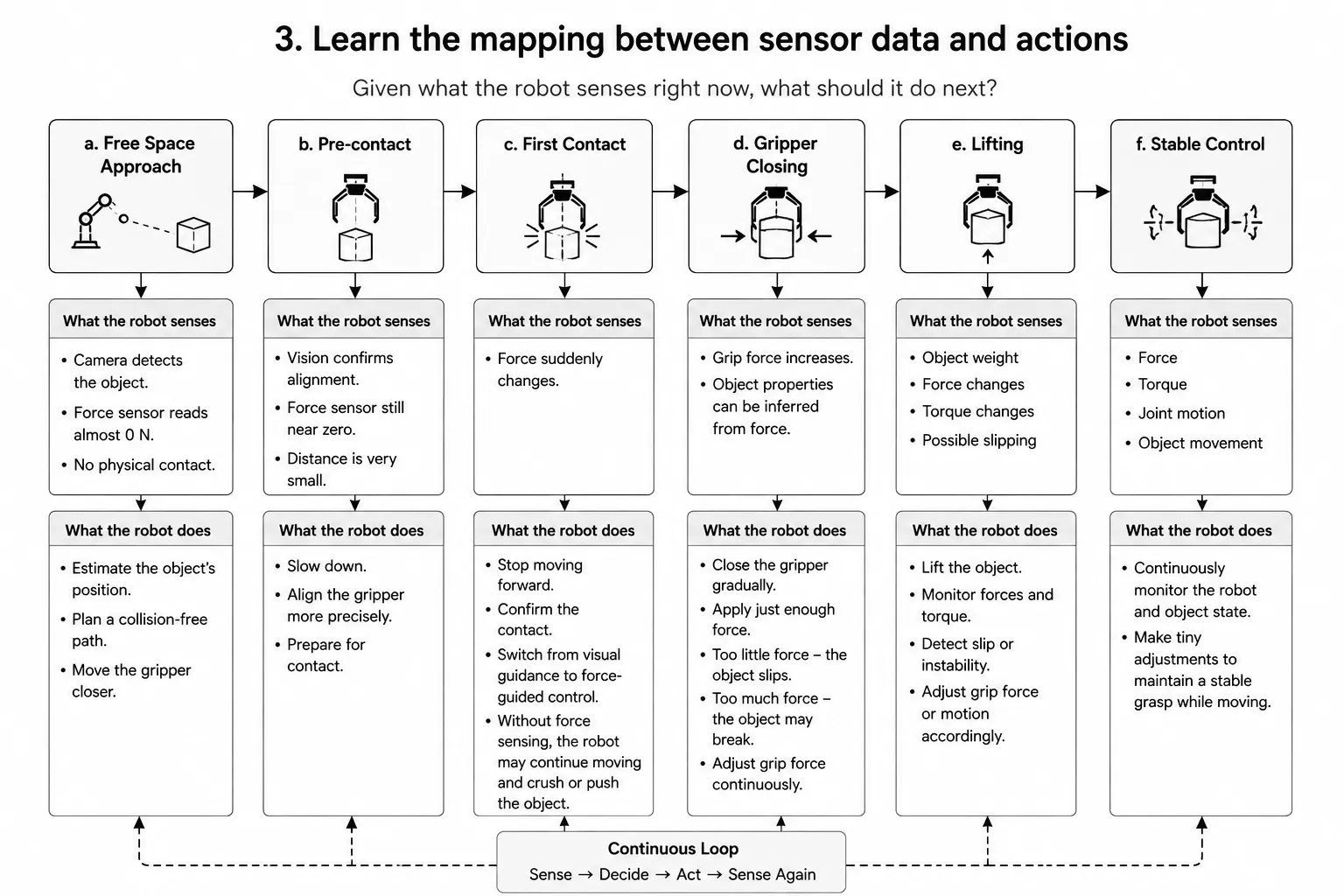
3. Learn the mapping between sensor data and actions
This simply means: “Given what the robot senses right now, what should it do next?” The robot continuously receives sensor inputs such as: Camera images Force sensor readings Torque readings Joint positions Gripper opening Tactile sensor data (if available)
a. Free-space approach
This is when the robot is moving toward the object but hasn’t touched it yet.
What the robot senses
- Camera detects the object.
- Force sensor reads almost 0 N.
- No physical contact.
What the robot does
- Estimate the object’s position.
- Plan a collision-free path.
- Move the gripper closer.
b. Pre-contact
Now the gripper is very close to the object. It still hasn’t touched it.
What the robot senses
- Vision confirms alignment.
- Force sensor still near zero.
- Distance is very small.
What the robot does
- Slow down.
- Align the gripper more precisely.
- Prepare for contact.
c. First contact
The fingers touch the object for the first time. This is where force sensing becomes extremely important.
What the robot senses
Force suddenly changes.
What the robot does
- Stop moving forward.
- Confirm the contact.
- Switch from visual guidance to force-guided control.
- Without force sensing, the robot may continue moving and crush or push the object.
d. Gripper closing
Now the robot begins closing its fingers. The goal is to apply just enough force. Too little force - the gripper may not close properly and the object slips. Too much force - the object may break.
The force sensor continuously measures grip force.
e. Lifting
Once the object is grasped, the robot starts lifting it. Now new forces appear.
What the robot senses
- Object weight
- Force changes
- Torque changes Possible slipping
f. Stable Control
Now the robot has successfully picked up the object. The challenge is maintaining a stable grasp while moving.
Example
Imagine carrying a cup filled with coffee. If someone bumps your arm, you instinctively tighten your grip. A robot does something similar. It continuously monitors: Force Torque Joint motion Object movement and makes tiny adjustments
4. Execute actions to perform the task
This is the final stage of the pipeline. By this point, the robot has already learned what action to take based on its sensor inputs. Now it must execute those actions in the real world while continuously adapting to new feedback. Execute actions to perform the task The AI model predicts the next action.
For example:
Move gripper +2 mm
Close gripper by 5%
Rotate wrist by 3°
Increase grip force by 1 N
Real-time business cases
The traditional industrial robots excel at repetitive, highly structured tasks, whereas force-aware robots enable automation of tasks involving uncertainty, physical contact, and adaptation.
Here are some strong real world industrial use cases.
- Electronics Assembly – Precisely inserts connectors and delicate components by sensing contact and resistance.
- Automotive Manufacturing – Assembles flexible parts like door seals, dashboards, and wiring without causing damage.
- Precision Screw Tightening – Applies the correct torque to fasteners, preventing under- or over-tightening.
- Warehouse Picking – Adjusts grip force to safely handle fragile, slippery, or irregularly shaped objects.
- Aircraft Maintenance (MRO) – Performs assembly and maintenance tasks by detecting contact and controlling applied force.
- Battery Manufacturing – Handles and assembles delicate battery cells with controlled pressure to avoid deformation.
- Food Processing – Grasps fruits, vegetables, and other soft food items without crushing or dropping them.
- Medical Robotics – Uses force feedback to perform delicate surgical and minimally invasive procedures safely.
- Surface Finishing – Maintains consistent pressure during polishing, sanding, grinding, and deburring operations.
- Collaborative Robots (Cobots) – Detects human contact and adapts its motion to enable safe human–robot collaboration.